I’ve lived in big modern apartment complexes with decent courtyards, but this post is on target despite the existence of exceptions. And even my apartment courtyard was a restricted access area, only open to apartment residents.
I spend a lot of time thinking about back to office, hybrid work, remote work, and so on. As is usually the case, Charity Majors has good thoughts on this. Her company is fully remote and distributed, and I believe that was true even before the pandemic; like many of us, she’s found that you still need that physical presence from time to time. Here’s how she does it.
I bought and read this dude’s book on Bahamian wrestling. It is incredibly niche and if you don’t like wrestling history as much as I do, you don’t need it — just read the article. It’s easy to write this kind of thing off as an artifact of the days before the Internet, and in some ways, yes. On the other hand, I know about a ton of little wrestling promotions in surprising places that are active right now; the world is not so small that you can’t still be surprised and delighted if you look.
I was chatting the other day about how I’d book an AEW round-robin tournament and I thought I’d expand on the subject somewhat here.
Background: most US pro wrestling tournaments are single elimination. There’s a bracket, and if you lose you’re out. In contrast, the big Japanese promotions tend to run round robin tournaments, where you earn points for wins, and the wrestlers with the most points face off in the finals.
Round robin tournaments chew up way more time. Typically, while something like NJPW’s G1 is going on, the majority of each show is dedicated to tournament matches. This would be hard for an American promotion.
The G1 has 20 wrestlers in two blocks. In each block, each wrestler fights every other wrestler in the block, so everyone has nine matches. That means you’re running 18 shows with four tournament matches apiece on them, and there’s no way AEW could devote over two months of TV time to something like that.
But the value of a round robin tournament is that you can book a lot of matches that might be awkward otherwise — faction members against each other, and so on. You can also do a few stunning upsets because nobody can be expected to win all their matches. So how would you make it work in the US?
I think you cut it down to eight wrestlers in two blocks of four. Now each wrestler only has three matches. Each week, you put two tournament matches on Dynamite and one on Rampage. One match is always the main event each night to maintain significance. Each block gets Dynamite one week and Rampage the second week, so over the course of the two week cycle each block completes one set of matches.
That means the whole tournament except the finals takes six weeks to run and only occupies a third of the available TV time. That’s not bad at all, even after you double it to fit in the women’s tournament.
Okay, how do you book it?
You run this at the end of the year. AEW resets win-loss records at the end of the year for the purpose of rankings. The first consequence of the tournament is that the wrestlers are seeded in the new year’s rankings based on their records. Come in third, and you’re third in the top five. Second, and more important, you give the winner the traditional shot at any title they want. Include tag team titles in that.
Finally, you determine the entrants by a mixture of skill and luck. First off, the top four wrestlers in the rankings as of the start of the tournament get in. That ensures you have stars. Second, you “randomly” pick four other wrestlers to fill out the field. That means you can give a newcomer a boost, you can set up inter-faction matches, all that good stuff.
And to maintain the gambling theme, you call it Hard Eight. You also get a bonus gambling note by using a roulette wheel or something to do the random selection.
[Crossposted from Population: One; go here for the original post.]
I enjoyed my first DEFY show enough to make it a regular thing. Last night they ran Seattle again, with Jeff Cobb on the show, which was more than enough to get me down there. It didn’t have any surprises like Moxley showing up but it was perfectly good indie wrestling and I’m looking forward to the next one.
I hit DEFY Wrestling: Mad Kingdom last night. Right before the pandemic, I had tickets for a DEFY show starring The Great Sasuke, plus they co-promoted the Super J-Cup show that S. and I went to in 2019. I thus had warm feelings, plus I’ve heard good things about them, plus Eddie Kingston was main eventing and like so many other fans I’ve been really impressed by his AEW run. So I decided to take a calculated risk and go out to an event.
It was pretty fun! Overall it wasn’t an exceptional show, but three of the matches were good to excellent and every match had something to like. I liked it enough to subscribe to their Patreon and I’m thinking I’ll make this a monthly excursion.
I wrote this up with vague plans to run a Season of it at some point, and I liked it enough to publish it. This is designed for use with The World Wide Wrestling RPG, second edition.
Professional wrestling is both a commodity and an art form, and that’s why I can sit in an audience of less than a thousand people in a small ballroom in Tacoma and watch one of the best wrestlers in the world do his job.
Will Ospreay is a British wrestler. He’s 26 years old. In 2007, he was a 14 year old watching this Latino kid called Amazing Red, who in turn was wrestling up and down the East Coast in a string of independent promotions and, for a while, in TNA. Whether or not TNA was the big leagues depends on who you ask. Either way, Red had the room to stretch the boundaries of his craft and Will was soaking it all in. He dressed like Red. He recorded YouTube videos of himself replicating Red’s moves.
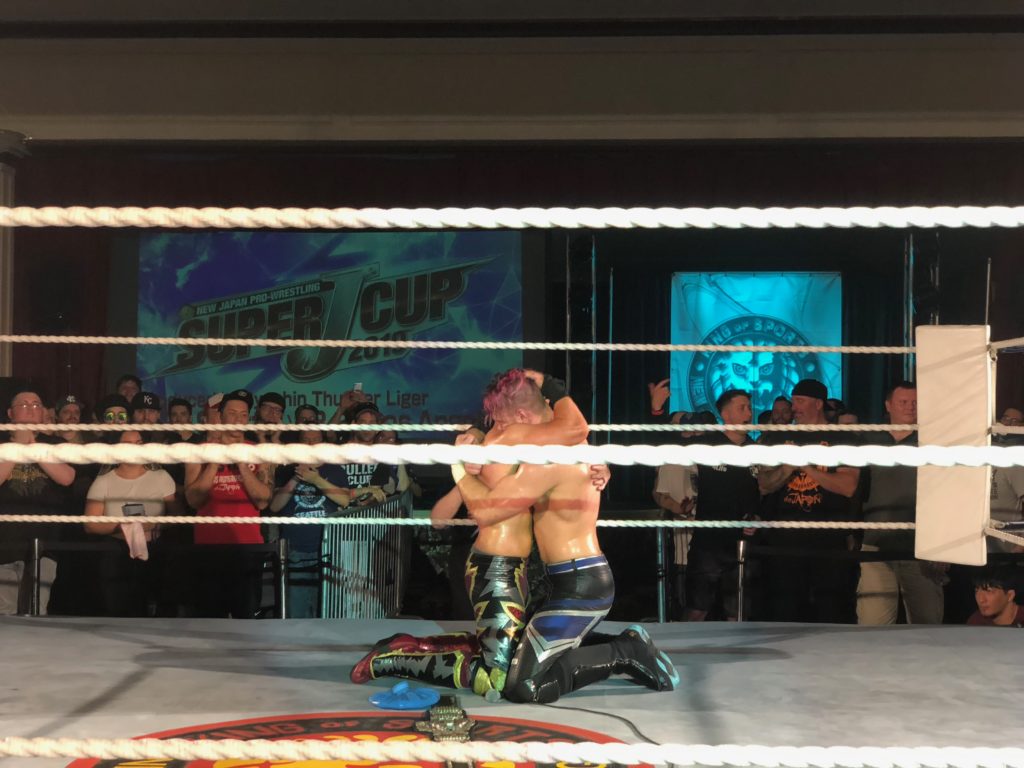
I know this because Will Ospreay told us so the other night, after 27 minutes of passionate wrestling against his idol, his voice cracking with emotion. Red felt it too, but he didn’t want to put what he was feeling into words. He just wanted to hug Will Ospreay and speak directly to him, whispers in his ear.
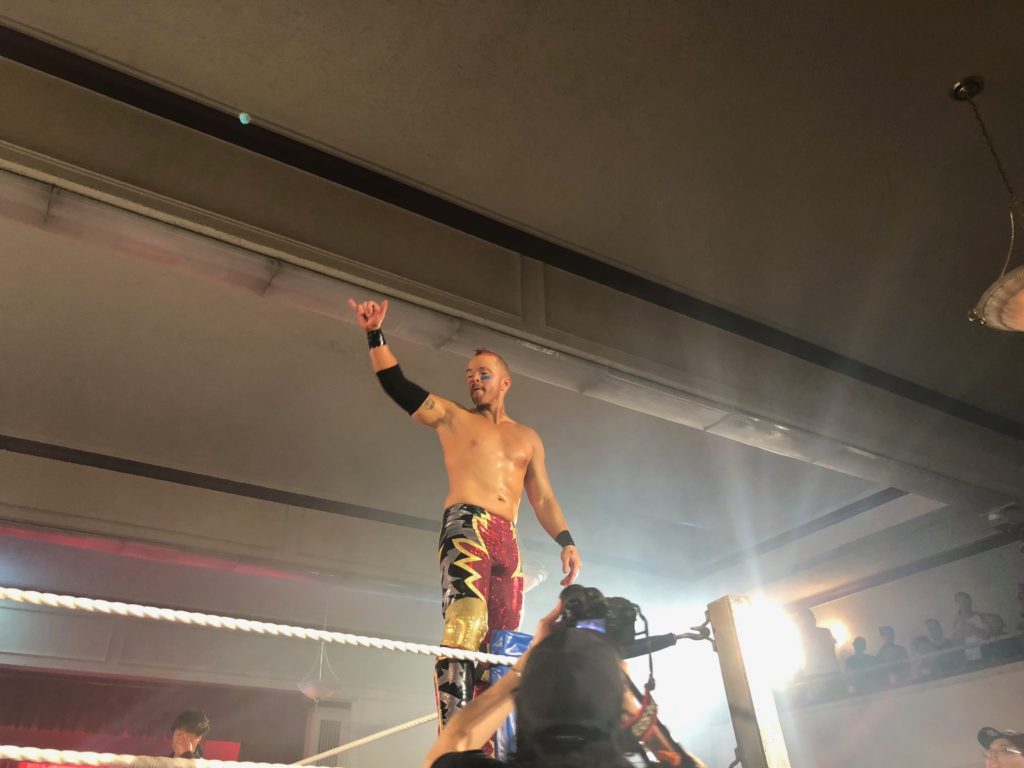
The aftermath
“Look at the names on this belt,” said Ospreay, as he held aloft his IGPW Jr. Heavyweight Championship belt. “Look at them. It’s a crime that your name isn’t among them.”
From time to time someone asks me why I like professional wrestling. It’s a good question, especially since sometimes I don’t like it very much at all. This is the answer. There are so many stories being told at once in a classic wrestling match. Some of them are fictional.
The other night, Will Ospreay and the Amazing Red told a story about a smaller, semi-retired guy battling one of the best wrestlers in the world. Will Ospreay wrestles as a junior heavyweight, but this summer he also competed in the G1 Climax tournament. That’s for heavyweights. Will won 4 out of his 9 matches against some of the best in the world. He’s over six feet tall. Amazing Red is 5′ 4″.
Unsurprisingly, Red wrestled as the underdog and came spitting distance from winning. That’s a pretty great story. Also great: watching these two master craftsmen sell that story. It’s not even remotely believable, except that they both knew how to make each other look good. At one point, Red hit his big match-winning move, his finisher. Ospreay didn’t kick out of it, because that would have established him as clearly superior. He just barely managed to get his foot onto the ropes, which breaks the pin without diminishing Red. Subtle stuff.
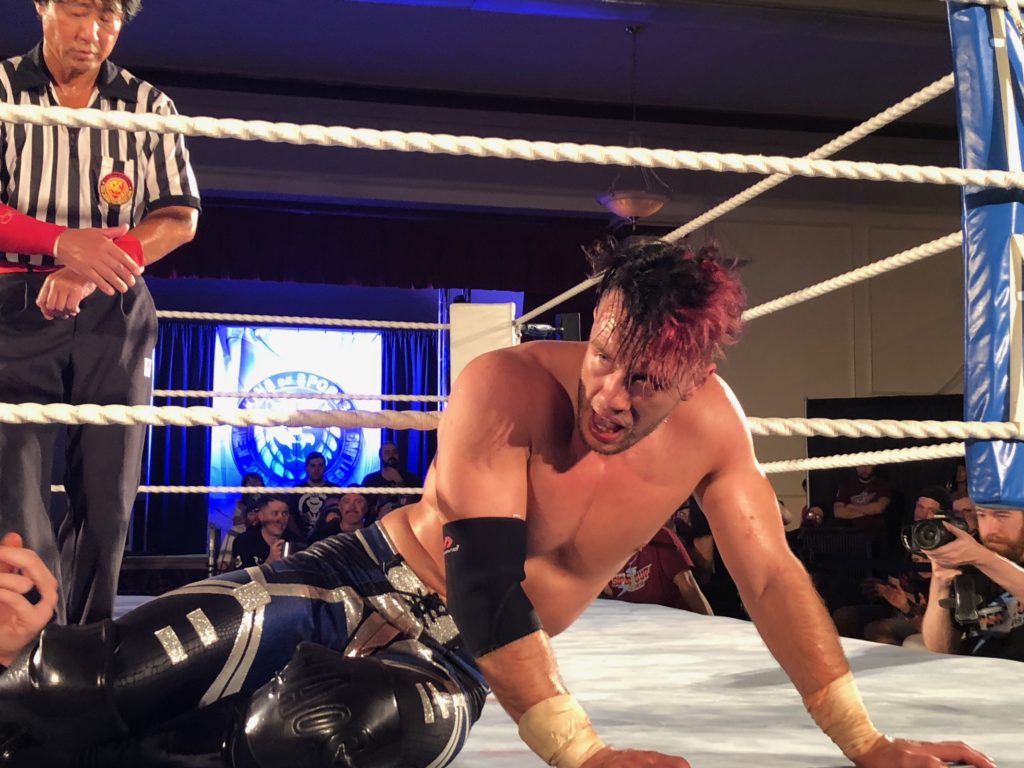
Ospreay, near-exhaustion
They also told a true story about a younger man and the veteran he idolized. Ospreay spent months begging Red to come out of retirement for this match, and obviously succeeded. That emotion was all over the match, and that post-match promo. It was also entwined in the fiction. Would Ospreay forget that he idolized Red and fight as hard as he could? Would he realize that he needed to stop idolizing Red in order to beat him?
They also told a story about two athletes and artists working their hearts out to entertain us. Under a thousand people in the room, and S. and I were in the front row. At one point Red wound up in the lap of the guy next to me. He reached up, grabbed my hand, got ready to pull himself up.
“Should I help?” asked the guy whose lap he was in.
“Nope, let it play out,” murmured Red. He was smiling so hard.
The Shawn Michaels Story — some repeats, no Bret Hart matches (?), but worth it probably for that hour long match with Cena alone. Said match is not included on the 3 DVD Cena set coming up soon, btw.
Rey Mysterio: Biggest Little Man — the 6 man tag from When Worlds Collide, the Malenko match from Great American Bash 1996, the July 8, 1996 Nitro Malenko match, the Eddie Guerrero match from Halloween Havoc 1997, his Smackdown debut against Chavo Guerrero in 2002, and the Angle match at SummerSlam 2002 are duplicates from his old DVD. C’est la vie. There’s a ton of new worthwhile material, although the old DVD is probably obsolete — the only match that isn’t repeated that’s worth seeking out is a Benoit match. Hm, and a Psicosis match, but still.
At the time I write this, the solid facts are that three people are dead: Chris Benoit, wrestler, and his wife, and their seven year old son. When I heard that news last night I was devastated. Chris Benoit’s death alone would have hit me hard; add a family tragedy to it, and the news horrified me.
![[personal profile]](https://www.dreamwidth.org/img/silk/identity/user.png)